This photograph was taken by Bernie Boston during a march protesting the Vietnam War at the Pentagon on October 21, 1967. It depicts a young man (later identified as George Harris) placing a carnation in the barrel of a national guardsman's gun. This later became known as the "Flower Power" Revolution.
giovedì 20 ottobre 2011
Technical (Band-aid Tool)- Alexandra
This is a photo I took of my friend while in Venice. I liked the crown graffiti in the photo; however; didn’t care much for any of the other graffiti directly behind her head. By using the band-aid tool found in Photoshop, one may easily remove this writing. Above, is a before and after picture after using the tool.
My Photo- Alexandra
This is a photo that I took on one of the beaches in Positano. I liked this picture because of the really apparent horizontal and vertical line. I thought it was also an interesting shot because of the fact that I was able to find an American flag on an Italian beach, which is very rare.
mercoledì 19 ottobre 2011
My photo - LEE
I took this photo in Villa D'este in Tivoli. This is Cento Fontane which means a hundred fountines in there. I like this photo showing every small one of a hundred.
Berenice Abbott - LEE
She was an american photographer who followed and helped Engène Atget. Her photos show the urban design of the 1930s and changes of urben cities in America. I think this photo reflects the dark side of a city, slums.
Engène Atget - LEE
Once again the photographer Engène atget who influenced Lee Friedlander. This photo was taken in France in black and white of Chiffonniers. I think this photo shows the figure of that period in 1913 by these working people in trashs.
Diane Arbus: AP
Diane Arbus, born March 14th 1923, was an American photographer and writer most known for her photographs of people whose "normality seems ugly or surreal". She committed suicide July 26th, 1971. Her photography was once famously compared to the reaction a child would have to the placement of a live bomb in their hands.
I like Diane's work because it is honest and raw. It does not camouflage how strange life can be. This photo is particularly interesting because it shows a mother in two very different stances. A sort of psychological shift is revealed through her stature.
My Photo: AP
I took this photo in Trastevere at dusk. I like it because the motor bike and the wall make a nice contrast between old and modern. The motorbike is also in a very animated position that which I think makes the photo interesting to look at.
Personal Photo - Joe
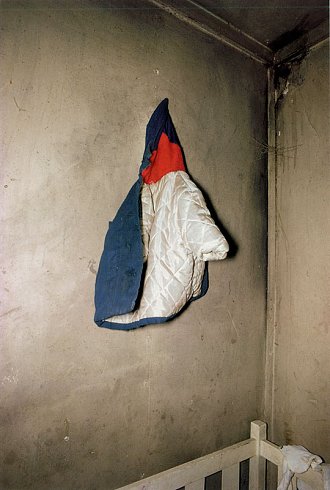
I took this photo at the museum that we visited last week. This was my favorite photograph there, so I though I'd take a photo of it. F/4, 1/125, ISO 1250.
Fotografia Festival - Alec Soth - KO
This picture by Alec Soth was in the exhibit we visited last week. Alec Soth is a photographer from Minnesota, known for photographing "loners and dreamers". I at first did not like many of his photos, however when I looked longer and saw that every photo told a story of the person in it and how they were in some way an outcast of society or different from the norm, I really gained an appreciation for his work. This photo in particular stuck out to me because of the vibrance of the woman's hair and how it is blowing in the wind. I feel as though her story is not as obvious as was many of the other subjects of Alec Soth's photos, but this is what I like about it.
William Eggleston 4 - KO
This is another photo by William Eggleston. I like how washed out the picture seems, but yet the red of the bicycle handle and the blue of the seat stand out. I like the perspective of looking up at the bicycle and how it makes it seem larger than the houses behind it. I also liked how even though the bicycle is stationary, the forward slanting lines of the bike make it seem like it is in motion, or ready to move at any moment.
My Photo - KO
I took this photo in Pienza, Toscana. I really liked the colors of the shoes and how they were positioned on the shelf. (ISO 100, f/2.8, 1/80sec)
International Photography Festival - Pita
An artist that had work at the festival was Nicole Voltan. This is particular is called Sistema Entropia, which translates to "Entorpy System." It tries to visualize the process as an entropic installation of fourteen back-lit photos to phosphorus, in which the multidirectional arrows mark the precise order of
reading of the work.
My Photo - Pita
This picture was taken right outside of the art studio. I took it with my 50mm lens and I love that the part of the plant that I am focusing on is very sharp and the background is completely blurred. I also like how the plant on the left is lighter than the bigger and darker plant on the right.
William Eggleston & Robert Frank - Pita
This is a photograph taken by William Eggleston, an American photographer born in 1939. He was influenced by the work of Robert Frank. Unlike Frank, Eggleston is known for increasing recognition of color photography. Prior to the 1970's black and white photography was the only medium to display in art studios. I like this picture because the angle and the contrast make this tricycle look like such a glorious object!
William Eggleston 3- Kirila
![]() |
| Untitled,1960-65 |
![]() |
| Near Jackson, 1970 |
At Harvard, Eggleston prepared his first portfolio, entitled 14 Pictures (1974). This portfolio was comprised of dye-transfer prints. Eggleston's work was featured in an exhibition at MOMA in 1976, which was accompanied by the volume William Eggleston's Guide. The MOMA show is regarded as a watershed moment in the history of photography, by marking "the acceptance of colour photography by the highest validating institution" (in the words of Mark Holborn). Eggleston's was the first one-person exhibition of colour photographs in the history of MOMA.
Around the time of his 1976 MOMA exhibition, Eggleston was introduced to Viva, the Andy Warhol "superstar," with whom he began a long relationship. During this period Eggleston became familiar with Andy Warhol's circle, a connection that may have helped foster Eggleston's idea of the "democratic camera," Mark Holborn suggests. Also in the seventies, Eggleston experimented with video, producing several hours of roughly edited footage Eggleston calls Stranded in Canton.
My Photo- Kirila
I took this photo few days ago while walking beside the Tiber. I like how the darker colors of the canoe, the water and the lower part of the bridge match and contrast the white color balanced between the bridge and the four people in the canoe. Also the particular shadow of the bridge creates interesting combination of crossing diagonal lines revealing a certain gradation of light from left to light. Moreover, the small details such as the graffiti and the pile of clothes on the right side of the river bank, add to the complexity of this seemingly simple photo.
lunedì 17 ottobre 2011
Alec Soth- Alexa
During our trip to the Fotografia Festival in Rome last week, one of the artists that caught my eye was Alec Soth. His art was very interesting, and what he decided to photograph was even more interesting and...unexpected. Upon further research for some less vulgar art of his, I found this adorable photo that really hits home for me. I love animals, and I happen to have a Siberian Husky at home in America waiting for me. When I saw this, I knew it was what I needed to post.
This is called "Dog days" by Alec Soth
How cute?
Robert Frank- Alexa
One of the influencers of Diane Arbus was Robert Frank. He took his photos in black and white, as did she, and he influenced her to create beautiful moments in monochrome by snapping people in their natural habitat. Although he took photos of "regular" and ordinary people, she decided to take pictures of those who weren't so ordinary. This picture I found of Robert Frank's was my favorite among the others. I love the flag, I love how the subjects are children, but mostly I love that they are reading about the monumental death of the famous Marilyn Monroe.
and of course, I love that it's black and white
My Photo- Alexa
I took this photo in 2008 on my second trip to Rome. My family and I took a tour through the Vatican Museums, and since that day this may have been my favorite picture i've ever taken. I didn't even have my fancy new camera at this point, but I still am blown away by how incredible the colors blend together, and how bright and beautiful they were when I first saw them.
Faith and Reason with St. Thomas Aquinas teaching in the background. This is known as one of the most beautiful allegories depicted as the harmony between Faith and Science. The artist name is Ludwig Seitz (1844-1908)
<3
mercoledì 12 ottobre 2011
My Photo-RS
I took this photo during class last week. I really liked the contrast between the green of the plant and the dark color of the door, as well as the different colors of the wall
my photo - LEE
I took this photo in Piazza Navona, with F5.6, ISO1600, 1\4 shutter speed. It was midnight but I could use that shutter speed, not 1 or 2 second because the moon was so bright and complete circle. I like this photo because it shows the old monument standing under the full moon and it looks so stable
the photographer who influenced Lee Friedlander - LEE
Lee Friedlander was influenced by several former photographers and Engène Atget was one of them. This photo is one of his famous photos named "organ grinder" taken in Paris in1898. He died in 1927. I think this photo is so historical because we can see how people in Paris, 1898 wore, how the street looked like, and what things they used.
photographer Lee Friedlander -LEE
I think the photos taken by Lee Friedlander are so strange. They all are white and black. And I think each photo is saying something or criticizing some phenomenon. I first choose him because "LEE" is included in his name but now I want to know what he wanted to show publics.
My Photo: AP
I took this photo in San Gimignano early in the morning around 7 am. It looks like a painting to me because of the way the fog is laying over the trees and hills. I like the fall colors and how the photo seems to capture Tuscany in a kind of dreamlike state, because it really is a place unlike any other in the world to me.
Cindy Sherman: AP
Cindy Sherman is an American photographer and was born January 19th, 1954. She is best known for her conceptual portraits. Sherman is still living and working in New York City. Sherman was originally a painter, but eventually felt that painting was very limiting and so transferred over to photography. Sherman is often the subject of her own photos. She plays multiple roles as model, photographer, costume designer, make up artist, director, etc. She is essentially an actress by becoming different characters for her photos. Through her work, Sherman also calls attention to the many ideas of feminism and how women play a role in society, media, and art.
Lee Friedlander & Robert Frank - Pita
My Photo - Pita
I took this picture in Tuscany this past weekend and I love that it is so representative of the area. The beautiful yellow walls, the narrow slopping path, and the shadows of the cyprus trees all highlight the amazing view of the rolling hills.
Personal Photo - Joe
I took this photo in Berlin last weekend. I like the settle focus and strong sun lens flare in this photo. The outline of light on her face and shirt also makes in interesting. (ISO 160 f/1.6 SS 1/400)
My Photo - KO
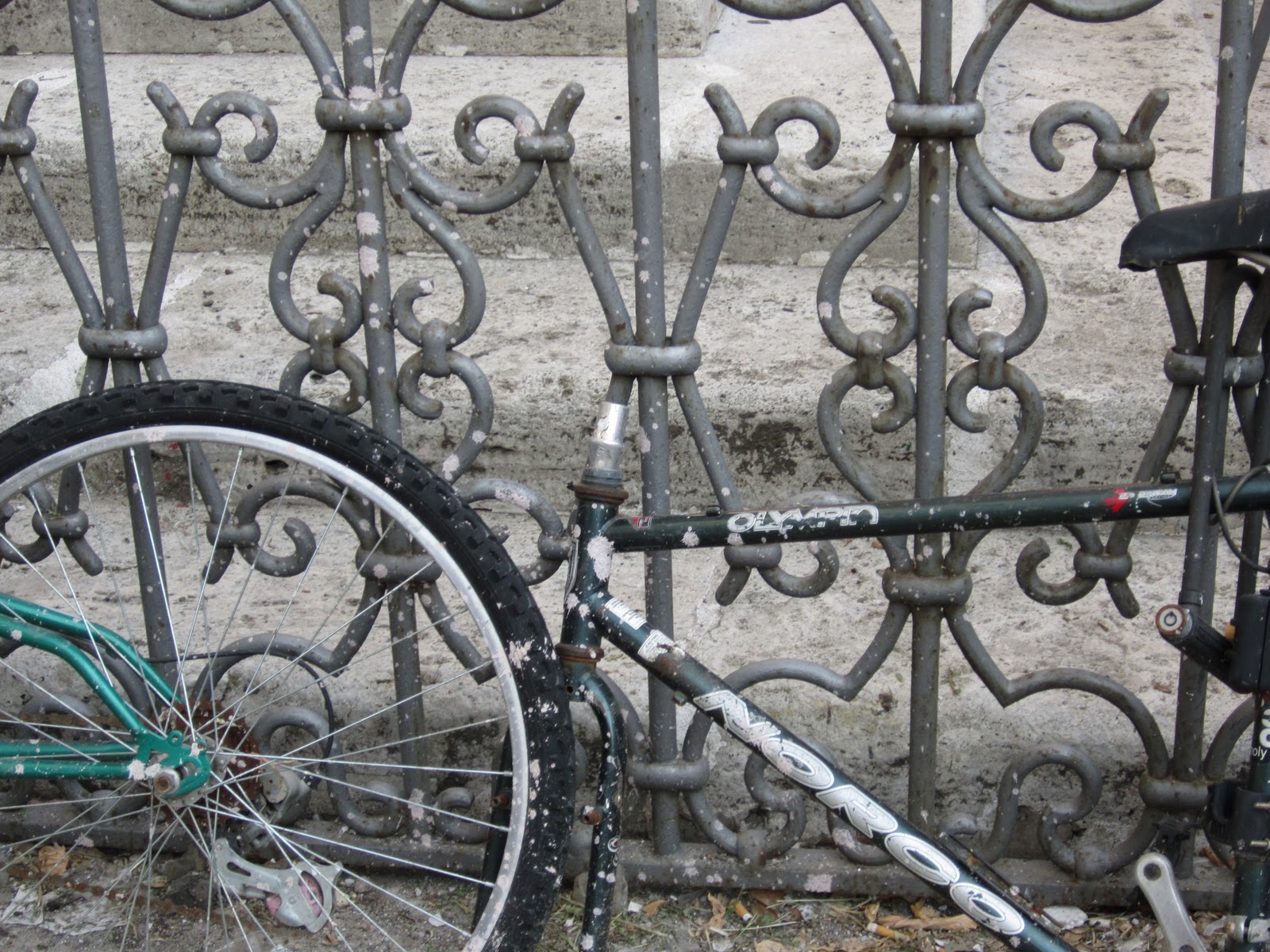
I took this picture while on our walk in class last week. I like the colors and the the worn look to the bike and the wall behind it. I also like the lone leaf underneath the pedals. (ISO 200, f/5.6, 1/50sec)
William Eggleston 3 - KO
As a product of photography in the 1970's, William Eggleston's works are very representative of the time and capture nicely, the culture, style and people. I love vintage/retro photography, which is what I love about William Eggleston's photography.
William Eggleston 2 - KO
What I like about William Eggleston's photography is the color in conjunction with the time and subjects of the photographs. He is able to capture ordinary, every day life in an artistic and beautiful way.
My photos- Kirila
I guess bikes are a quite important part of Rome, since each corner of the streets is occupied by them, wheter new ones or broken ones. They contribute to Rome's unique appearance as a city, attracting the eyes of the tourists and everyone else.
William Eggleston - KO
William Eggleston was born on July 27, 1939 in Memphis, Tennessee, although he was raised in Sumner, Mississippi. He is an American photographer, known for his color photography. His early photography career was influences by Henri Cartier-Bresson's book "The Decisive Moment" and by Robert Frank.
Although known for his color photography today, he originally started out with black and white photography. For the most part, William Eggleston developed his photography on his own, but William Christenberry of the Memphis College of Art initially introduced him to color photography. In 1973 and 1974, William Eggleston taught at Harvard and there he discovered dye-transfer printing, which he used from there on out. The photograph above, entitled "The Red Ceiling", is Eggleston's first experience with using dye-transfer printing and the reason he fell in love with the technique.
William Eggleston 2- Kirila
''The red ceiling''
Eggleston's subjects take on a kind of devil-may-care vulgarity. Walker Evans's careful studies might impart poetic dignity to everyday objects, but where was the poetry in Eggleston's images of a jumble of shoes under a bed, a refrigerator crammed with frozen food and an utterly unremarkable shower-cubicle?
His work certainly shocked the critics at his 1976 exhibition at New York's Museum of Modern Art. One damned it as an example of "the banal leading the banal". The New York Times called it "the most hated show in town". But Eggleston's fame increased with a remarkable sequence of books. They included "Election Eve", atmospheric shots of Jimmy Carter's Georgian hometown in 1976; "Graceland", chilling views of Elvis Presley's mansion-mausoleum; and "The Democratic Forest", a wide-ranging, almost Zen-like compilation of the bewildering variety of American life.
Eggleston has said he is "at war with the obvious", but the obvious forms some of his most effective subjects. Grouped together, as at "Ancient and Modern", his views of the everyday become not just conventionally poetic, but weird, touching, disturbing, banal and--not infrequently--unexpectedly beautiful. Detractors have said he has "no respect for the medium" because of his willingness to take pictures just as they come, even sometimes removing the viewfinder from his camera to shoot literally from the hip. Conversely, however, he seems to have great respect for the manifold images of life--high, low or middling--that photography can produce.
http://search.proquest.com/docview/224164208/1325D0228AA976B26E/1?accountid=130118
''Torch cafe''
http://search.proquest.com/docview/224164208/1325D0228AA976B26E/1?accountid=130118
venerdì 7 ottobre 2011
RAW vs JPEG- Alexa
Most people would argue that RAW photos often come out clearer, whereas the JPEG photo does not. In this case, for me, I feel as if the JPEG file is much more clear. The JPEG was not blurry, and the reflection in the sunglasses was much more vivid.
giovedì 6 ottobre 2011
Wandering - Alexa
I took these during our class walk to the furniture/carpentry store. I love taking black and white photos, especially outside. I like the lines that the building creates and how mysterious this came out.
This class has gotten me into the swing of taking pictures of things I wouldn't normally photograph. The lighting in this picture might be too dim, but I like how bright one side of the pipe was compared to the bottom, and this vibrant yellow really stood out to me. I also like the lines that the pipes create and how pop-art this picture is. My camera was set to ISO800, auto white balance and low exposure.
Candid Capri Weekend- Alexa
This is my best friend Ryan. It's his first time out of America and he absolutely loves everything about Italy. Going on a weekend trip to Capri was a perfect way for him to see how beautiful everything in Italy is. This is he on a boat tour around the island of Capri, and I think I perfectly got his happiness in one shot. It's definitely being framed when we get back to America.
To save myself from uploading 5 posts just from this past weekend alone, i'll combine them into one post.
This next picture is at the top of Anacapri. After the horrifying tram ride up the mountain, we managed to get one good shot of the both of us happy with the gorgeous scenery in the background. I love Capri <3
Grotto-Alexa
This is my photo from the Blue Grotto during my weekend in Southern Italy. Every time I've been in there, it never gets old or any less breath taking. That color is something that cannot be replicated anywhere, and i'm so grateful to have experienced it with my best friends.
I got this right as the next boat was entering the grotto and I was very impressed with the clarity and how bright the blue is. This one is going in my book!
Arbus three- Alexa
‘A photograph is a secret about a secret. The more it tells you the less you know.’
In this photo, I was able to find one where someone captured her in the act of photographing someone in their natural element. Even though you can't see her subject, you can still manage to see her concentration while trying to capture that special moment.
Arbus-Alexa
Diane Arbus was known for her funky, abstract photos of people who deviate from the social norm. Sifting through her pictures, she seems to perfectly grab the one second where these people may be considered beautiful. This next picture is one of two children laughing, although they don't necessarily fit the "cute" criteria in the world today. I like this because it captures a moment of pure innocence.
Diane Arbus Art- Alexa
Diane Arbus is an American photographer and writer known for her black-and-white square photographs of "deviant/marginal" people (dwarves, giants, transvestites, nudists..etc) or people normally seen as "ugly" or "surreal." She was such an inspiration as an artist, Nicole Kidman portrayed her life in the motion picture, Fur. The next couple of posts are my favorite pictures from her collection.
This picture caught my eye, I loved the carpet (which might be a focal point) and of course the adorable little dog accompanying her as she poses. I also love how retro this looks.
Ugo Mulas 2-sarahlynn
After researching more of Mulas' life, I became fascinated into his relationship to Pop Art. In fact, the picture above features Andy Warhol and one of his superstars Edie Sedgwick. Being fond of Pop Art, I appreciate Mulas' effort to provide the link from the pop artists to the public.
Another one of my favorite pop artists, Roy Lichtenstein, is creatively portrayed by Mulas. I really like how Mulas reverses the role of painter and character by portraying Lichtenstein in a way that he appears to be a character in one of his paintings.
Both photos are aligned with the following quote by Mulas,
"When photographing a painter, I often try a chance to come out from the photo that is the record, I also try to avoid the usual portrait, beautiful picture, because I'm interested in is to give an idea of the character in relation to the result of his work, ie to understand which of his ways and attitudes is crucial for the final result. "
Iscriviti a:
Post (Atom)